Query String Forwarding: forward parameters to sub-requests
Query String Forwarding adds selected query string parameters to nested file addresses in a playlist before Orange's CDN returns the file. It is mainly used for HLS and MPEG-DASH video, where a viewer requests a master manifest first, and that manifest references rendition manifests, media segments, subtitles, or other related files.
A viewer requests a protected HLS master manifest with a secure token:
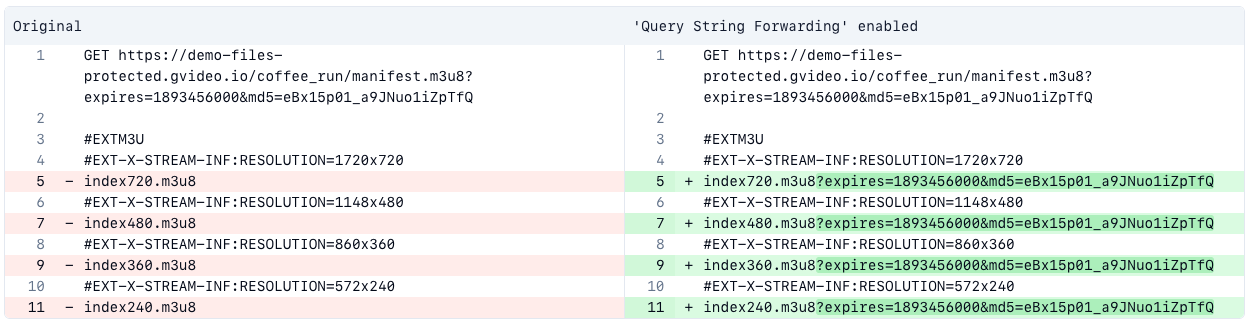
Without this option, URLs for nested manifests and segments in the playlist stay unchanged, so they have no query string parameters:
manifest.m3u8?expires=1893456000&md5=eBx15p01_a9JNuo1iZpTfQ
index720.m3u8                 <= as is, without token parameters
chunk720-1.ts                 <= as is, without token parameters
When Query String Forwarding is enabled, the CDN inserts the md5 and expires parameters from the initial request into nested manifests and segments:
Links to demo files are valid until January 1, 2030.
HLS and MPEG-DASH playlists keep a secure token on md5 and expires.
A player requests one playlist, and that playlist names the renditions and segments without the query string from the first request. Query string forwarding copies selected parameters onto those nested addresses. Orange's CDN rewrites the links inside the playlist before it returns the file.
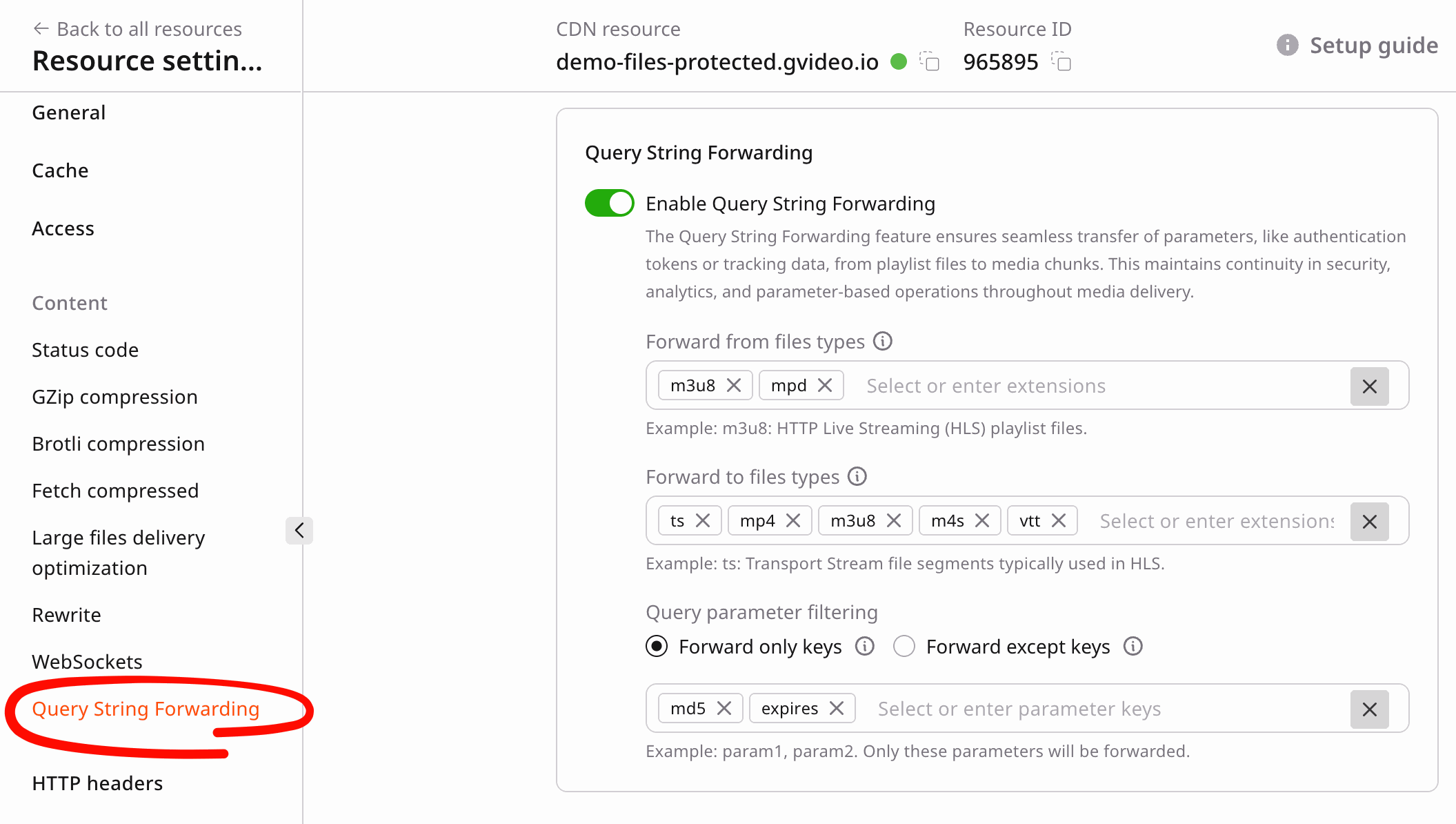
Copy md5 and expires from requests for m3u8 and mpd files onto the nested ts, mp4, m3u8, m4s, and vtt files.
enabled, forward_from_file_types, and forward_to_file_types are required. Each list needs at least one value, with no repeats, and each extension is written without a leading dot. forward_only_keys and forward_except_keys cannot be sent in the same request.
Set enabled to false and send the same file types and keys. Orange's CDN keeps the saved lists and stops copying the parameters. enabled alone returns HTTP 400, because the file-type lists are still required.
The Terraform provider v2 adds md5 and expires from a playlist request to the nested file addresses before Orange's CDN returns the playlist. A master manifest requested with those parameters is returned with the same parameters on the rendition and segment links. Run terraform apply after editing options.
Forward selected parameters
Orange's CDN rewrites links inside m3u8 and mpd files so nested ts, mp4, m3u8, m4s, and vtt files receive md5 and expires from the parent request. Set enabled to true. forward_from_file_types and forward_to_file_types are required. Write each extension without a leading dot.
forward_only_keys lists the parameters to copy. forward_except_keys lists parameters to leave out. Sending both returns HTTP 400.
Set enabled to false and keep the same file types and keys. Orange's CDN keeps the saved lists and stops copying the parameters. A resource created without this block leaves query string forwarding unset.